
Residual Current Transformers | Monitoring for Hospitals Residual current transformers and residual current monitors are critical safety components in modern hospital electrical systems. From operating…
Residual Current Transformers | Monitoring for Hospitals
Residual current transformers and residual current monitors are critical safety components in modern hospital electrical systems. From operating theatres and intensive care units to imaging suites, laboratories, and sterilisation areas, healthcare facilities depend on stable power across low voltage and medium voltage hospital distribution grids that interface with external power grids and local distribution grids. Medical IT systems and sensitive industrial electronics must operate without unsafe leakage currents. Cleaning chemicals, steam, disinfectants, long cable runs, mobile medical devices, and constant 24/7 operation all increase the risk of insulation degradation, insulation aging, earth leakage faults, and hidden electrical anomalies.
A correctly selected residual current transformer for hospitals, combined with hospital residual current monitoring using advanced RCMs and insulation monitoring devices, provides early fault detection and continuous protection for life-support systems, isolated power systems (IPS), and critical distribution boards. These solutions sit at the heart of hospital condition monitoring, enabling online measurement of leakage and load currents under real operating conditions. This category page explains how residual current transformers (RCTs), residual current monitors (RCMs), insulation monitoring devices for hospitals, and general current monitors work together to deliver medical electrical leakage detection, protect patients, and support compliance with AS/NZS 3003 and IEC medical standards.
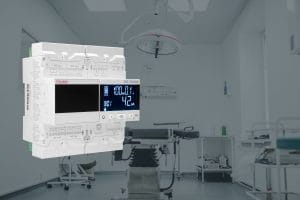
Safeguarding Electrical Systems – The Imperative of Current Monitoring
Hospital environments place unique demands on electrical safety. Operating theatres, cardiac-protected areas, and body-protected areas must maintain strict limits on touch voltage and leakage current so that patients connected to medical equipment are never exposed to dangerous electric potential differences. Medical IT systems and isolation transformers are designed to reduce the risk of electric shock, but they still require continuous insulation monitoring and leakage current waveforms tracking to remain safe over time.
Moisture from humidification and cleaning, aggressive disinfectants, frequent plug-in/plug-out of mobile equipment, cable flexing, and thermal cycling inside distribution boards all contribute to insulation wear and gradual loss of dielectric strength. External plant exposed to weather conditions such as light rain, heavy rain, and dew point condensation, combined with conductive pollutants on surfaces, can further stress insulation and high voltage insulators on incoming feeders and transmission line interfaces. Without hospital electrical safety monitoring in place, total leakage current and earth faults can remain invisible until they cause shock incidents, unexpected equipment shutdowns, or fires in critical care areas. Continuous current monitoring turns these hidden risks into measurable, actionable data so hospital facility teams can intervene early.
The Unseen Dangers of Electrical Faults: From Shock Hazards to Fire Risks
In a hospital, even a relatively small residual current can have serious implications. Leakage current that might be tolerable in an industrial plant can be hazardous when a patient is connected to invasive equipment or cardiac monitoring leads. Undetected faults can:
- energise metal bed frames, theatre tables, and IV poles
- disturb the operation of monitors, ventilators, and infusion pumps
- trigger nuisance alarms or shutdowns in imaging suites
- increase fire risk in sterilisation rooms, plant spaces, and equipment rooms
As insulation deteriorates, partial discharges, changes in dielectric modulus, and partial discharge pulses may occur inside cables, isolation transformers, or switchgear. By deploying residual current transformers in hospital distribution boards and RCM for medical facilities on key outgoing circuits, facility managers can continuously track residual currents, assess RMS values and LC peaks, identify developing insulation faults, and protect both patients and staff from shock and fire hazards.
A Holistic Approach to Electrical Safety Monitoring
Hospitals cannot rely on a single protection device. A robust healthcare electrical protection system typically combines:
- Residual current transformers for medical IT systems and general supply circuits
- Core balance current transformers for isolation transformer outputs
- Residual current monitors (RCMs) dedicated to operating theatres and critical care units
- Insulation monitoring devices for hospitals supervising isolated power systems (IPS)
- General current monitors on pumps, HVAC, UPS, and generators
- Alarm and annunciation panels that provide clear indication in theatre and engineering control rooms
- Upstream surge protection, including surge arresters, High Resistance Grounding arrangements, and neutral grounding resistor systems where appropriate to manage ground-fault energy
Together, these devices form a layered defence that ensures compliance with medical standards while maintaining continuous operation of vital clinical services from the main incomer right through to local distribution grids.
Understanding the Threats: Residual Currents and Other Electrical Anomalies
Hospitals face a mix of electrical challenges beyond basic overloads. Key issues include:
- Residual currents from insulation degradation, moisture ingress, and damaged cables
- Resistive leakage current caused by contamination and conductive paths on surfaces
- Capacitive leakage currents associated with isolation transformers and long cable runs
- Complex LC waveforms and distorted voltage waveforms caused by power electronics
- Harmonic distortion from imaging systems, VSD-driven pumps, and electronic loads
- Neutral-to-earth faults in TN systems supplying plant areas
Effective hospital electrical safety monitoring requires visibility into all of these behaviours so maintenance teams can distinguish between normal operating leakage and dangerous fault conditions, and to maintain overall insulation performance of the network.
What Are Residual Currents? The Concept of Differential Current
Residual currents arise when the vector sum of currents flowing in the conductors of a circuit does not equal zero. In hospitals this imbalance usually indicates:
- leakage via damaged or aged insulation
- current flowing through unintended paths, such as wet surfaces or metallic frames
- contact between conductors and earth within equipment or wiring
A residual current transformer for hospitals encircles all active conductors in a circuit. Under healthy conditions, the magnetic field produced by currents in each conductor cancels out. When leakage occurs, the imbalance generates a net magnetic flux in the RCT core, which is then converted into a proportional signal for the RCM, insulation monitor, or protection relay. Many modern RCT systems are paired with current measurement devices that use precision electronics, Hall current sensors, or even an optical sensor to capture detailed leakage current waveforms and associated LC peaks and RMS values. This approach works for both medical TN systems and medical IT systems when devices are appropriately selected and tuned.
The Hazards Posed by Residual Currents: Personal and Equipment Risks
Uncontrolled residual currents in hospitals can:
- expose patients to dangerous touch voltages in body-protected and cardiac-protected areas
- interfere with sensitive diagnostic or monitoring equipment
- cause insulation breakdown in isolation transformers and medical IT circuits
- overheat connections and terminals in distribution panels
- escalate into fires in cable ducts, risers, and plant rooms
Because many patients cannot move or perceive danger, medical equipment leakage current monitoring is non-negotiable. Continuous residual current monitoring, combined with on-line monitoring of insulation resistance, allows hospitals to detect and correct problems while equipment remains in service, instead of relying on periodic manual checks alone.
Beyond Residuals: Other Critical Current-Related Hazards
While residual current detection focuses on leakage paths, hospitals must also manage other current-related hazards, including:
- Overcurrent and overload in HVAC, pump, and sterilisation systems
- Underload and jam detection in critical plant (e.g., vacuum pumps, medical gas compressors)
- Phase imbalance affecting imaging equipment and large chillers
- Inrush currents and harmonics generated by electronic power supplies and VSDs
Using general current monitors alongside RCTs and RCMs helps engineering teams track abnormal load profiles, implement robust condition monitoring, and schedule routine maintenance based on real field measurements, reducing the chance of unexpected outages that disrupt clinical operations.
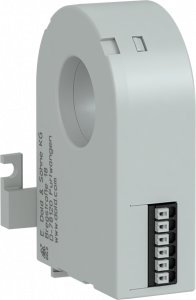
Residual Current Transformers (RCTs) – The Foundation of Leakage Detection
How Residual Current Transformers Work: Principles and Operation
Residual current transformers form the sensing backbone of hospital residual current monitoring. Installed around the active conductors of a circuit, they detect differential current by measuring the net magnetic flux caused by leakage. High-quality RCTs are engineered using finite-element analysis of cores and LC waveforms so they remain accurate over a wide range of load currents, fault magnitudes, and distorted voltage waveforms typical of modern medical and plant equipment.
When connected to an RCM or insulation monitoring device, the RCT provides a highly sensitive indication of earth faults or developing insulation problems in operating theatres, ICUs, imaging rooms, and general wards. In more complex hospital networks fed from medium voltage substations, RCTs on the low voltage side help bridge the safety gap between upstream power grids and downstream IPS circuits.
Types of RCTs and Their Applications: Tailoring Detection to Fault Characteristics
Hospitals use different RCT types to match specific applications:
- Type A RCTs for AC and pulsating DC leakage in general medical equipment
- Type B RCTs for smooth DC and high-frequency leakage associated with imaging systems and VSD-driven plant
- Large-aperture RCTs on isolation transformer feeders or main theatre distribution boards
- Compact RCTs on individual medical equipment circuits or socket outlet groups
Correctly matching RCT performance to the medical equipment leakage current profile, including expected LC waveforms and leakage current waveforms, ensures accurate detection without nuisance alarms.
Installation and Sizing Considerations for RCTs
For reliable operation in hospitals:
- all active conductors of the monitored circuit must pass through the RCT
- the internal diameter must suit cable bundles or busbars while minimising excess air gap
- routing should avoid strong external magnetic fields, especially near imaging equipment
- mounting must withstand mechanical vibration and routine cable movement
- sensitivity settings must align with AS/NZS 3003 limits and hospital risk assessments
Thoughtful installation, supported by commissioning field measurements and occasional field trials, ensures accurate readings and reduces the risk of spurious alarms in critical clinical spaces.
Integration with Safety Devices: From Relays to Circuit Breakers
Residual current transformers interface with:
- hospital RCMs and insulation monitors for medical IT systems
- earth leakage relays on plant and service circuits
- alarm panels in operating theatres and control rooms
- PLCs, BMS, and SCADA systems used by engineering departments
- circuit breakers and contactors for controlled disconnection of non-critical loads
- upstream protection that may include surge arresters and high voltage insulators on medium voltage or transmission line feeders
This integration allows hospitals to implement selective tripping strategies where non-essential circuits can disconnect automatically, while IPS and life-support systems generate alarms and prompt maintenance rather than abrupt shutdown.
Residual Current Monitors (RCMs) – Continuous Vigilance and Active Protection
The Role of RCMs in Proactive Electrical Safety
Residual current monitors for medical facilities provide continuous, high-sensitivity supervision of leakage currents without necessarily disconnecting power. In hospitals, RCMs are deployed on:
- operating theatre isolated power systems
- intensive care and high-dependency unit circuits
- imaging suites and critical diagnostic areas
- essential services distribution boards
They enable proactive hospital electrical safety monitoring, highlighting developing faults long before they reach unsafe levels or cause equipment shutdown. Integrated on-line monitoring functions allow engineers to trend RMS values, LC peaks, and total leakage current for each circuit.
Key Features and Functionality of Modern RCMs
Modern RCM for medical facilities typically offers:
- adjustable trip and alarm thresholds suitable for medical environments
- true RMS values measurement of AC, DC, and mixed-frequency leakage currents
- fast response for serious faults combined with delays to avoid nuisance triggers
- local LEDs, an insulation indicator, and displays showing leakage levels and alarm status
- analogue outputs or Modbus/ethernet links to BMS and SCADA systems
- event logging for trend analysis, compliance records, and fault investigation
Many systems can be paired with complementary diagnostics such as infrared imager surveys, thermal image inspections, and sensor-based monitoring device add-ons to provide a deeper view of transformer and cable health. These features simplify medical IT system insulation monitoring and support predictive maintenance strategies.
RCMs in Specific Critical Applications
Key hospital applications include:
- operating theatres and procedure rooms: monitoring isolation transformer outputs and socket groups
- cardiac-protected areas: ensuring leakage stays within strict thresholds
- ICUs and HDUs: supervising power to life-support and monitoring equipment
- imaging suites: tracking leakage from MRI, CT, X-ray, and associated cooling systems
- central plant rooms: monitoring essential HVAC, medical gas, and pump circuits
By tailoring settings to each application, hospitals can balance sensitivity, stability, and clinical needs.
Differentiating RCDs from RCMs
It’s important to distinguish RCDs from RCMs in medical environments:
- RCDs (Residual Current Devices) disconnect power automatically when thresholds are exceeded; they are suited to general power outlets and plant services where sudden disconnection is acceptable.
- RCMs (Residual Current Monitors) continuously supervise leakage without necessarily tripping; in medical IT systems and critical circuits they trigger alarms and maintenance actions instead of immediate disconnection.
Hospitals rely heavily on RCMs because life-support and theatre equipment cannot simply turn off whenever minor leakage variations occur.
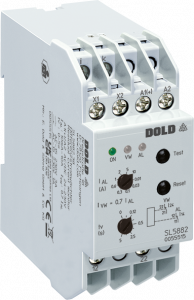
General Current Monitors – Beyond Residuals for System Health and Performance
Broader Current Monitoring for Preventative Maintenance
Beyond leakage, hospitals benefit from general current monitoring that highlights mechanical and electrical issues in plant and building services. Current changes often indicate:
- failing bearings in pumps and fans
- blocked filters or duct restrictions in air-handling units
- jammed compressors or vacuum pumps
- abnormal loading on chillers and boilers
By tracking these patterns, facility teams can plan interventions before failures disrupt clinical operations. Combined with periodic field measurements, thermal image surveys, and infrared imager inspections, this forms a robust condition monitoring program.
Types of Current Monitoring: True RMS, Adjustable, and More
Common devices include:
- True RMS overload relays for non-linear loads such as VSD-driven equipment
- underload and jam detection relays for pumps, fans, and compressors
- phase failure and imbalance monitors for three-phase plant and imaging systems
- multifunction protection relays combining voltage, current, and power-factor monitoring
These devices complement residual current transformers and RCMs to give hospitals complete visibility of their electrical infrastructure and associated voltage waveforms.
Applications of General Current Monitoring
Typical hospital applications:
- chilled water, heating, and ventilation systems serving theatre and ward areas
- medical gas compressors, vacuum pumps, and sterilisation plant
- domestic water booster sets and wastewater pumps
- UPS output circuits and generator supply lines
- lifts, escalators, and critical facility infrastructure
Reliable operation of these systems is essential for maintaining safe, compliant patient environments.
Integration with Control Systems and Safety Relays
General current monitors often integrate with:
- BMS and SCADA systems for alarm display and trending
- PLC-controlled plant for load-based control strategies
- safety relays and interlocks where plant failure affects critical pressure, temperature, or airflow
This integration ensures current anomalies translate into actionable alarms or automated responses.
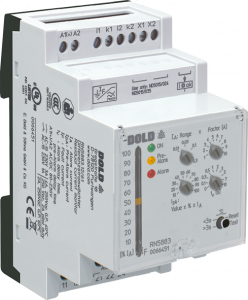
The Synergy of Safety: Creating a Comprehensive Electrical Protection Strategy
How RCTs, RCMs and Current Monitors Complement Each Other
A high-performing hospital electrical safety monitoring strategy combines:
- RCTs for accurate leakage sensing
- RCMs and insulation monitors for continuous supervision of medical IT systems
- RCDs for automatic disconnection on non-critical circuits
- general current monitors for plant and services
Working together, these devices provide early warning, selective disconnection, and predictive maintenance data across the entire hospital. Analytics platforms often use support vector–based models, such as a support vector machine or other hybrid model approaches, to correlate leakage trends with environmental factors and plant status.
Meeting Regulatory Compliance: Standards and Best Practices
Hospitals must comply with:
- AS/NZS 3003 and related medical electrical installation standards
- IEC and local wiring rules covering medical IT systems and isolated power systems
- internal policy requirements on patient safety and equipment reliability
Continuous logging of leakage levels, periodic testing of alarms, and proper documentation of RCM settings all help demonstrate compliance and support accreditation processes. Where upstream systems use High Resistance Grounding and a neutral grounding resistor, monitoring ensures ground faults remain limited and clearly detectable.
The Cost-Benefit of Proactive Monitoring
Investing in residual current transformers and insulation monitoring devices for hospitals yields clear benefits:
- reduced risk of electric shock to patients and staff
- lower likelihood of fires and equipment damage
- fewer unexpected outages in theatres, ICUs, and imaging suites
- improved asset life and planned maintenance scheduling
When weighed against the cost of theatre downtime, cancelled procedures, or equipment replacement, proactive monitoring is a small price to pay.
Selecting and Implementing Current Monitoring Solutions
Key Factors in Choosing the Right Devices
When selecting RCTs, RCMs, and current monitors for hospitals, consider:
- leakage sensitivity and measurement range appropriate to medical applications
- compatibility with medical TN and IT system monitoring requirements
- ability to detect AC, DC, and mixed-frequency leakage currents and complex LC waveforms
- aperture size and mounting options for existing cables and busbars
- communication protocols for connection to BMS/SCADA
- compliance with AS/NZS, IEC, and manufacturer recommendations for medical equipment
Engineers may also evaluate algorithms by their true positive rate, false positive rate, and ROC curve performance when deciding on advanced fault-detection platforms. A tailored approach ensures each clinical and plant area gets the right level of protection.
Installation Best Practices: Ensuring Accuracy and Reliability
Best practice in hospital installations includes:
- routing all relevant conductors through each residual current transformer
- avoiding external magnetic influences, especially near MRI or large transformers
- clearly labelling monitored circuits and alarm points
- checking polarity and configuration for medical IT systems and isolation transformers
- verifying settings through commissioning tests and simulated fault conditions
During maintenance, teams may use a conductivity meter to check water quality around plant, an insulation indicator to verify resistance levels, and targeted field measurements to ensure that online measurement data from RCMs matches actual site conditions. Correct installation ensures that the monitoring system reflects real conditions rather than introducing false positives.
Maintenance and Testing: Ensuring Ongoing Safety Performance
Ongoing assurance requires:
- routine testing of RCM alarms, insulation monitors, and annunciators
- trending of leakage currents to identify gradual insulation aging and deterioration
- regular verification of isolation transformer performance and IPS operation
- review of event logs following incidents or power quality issues
Combined with field trials, periodic inspections using infrared imager and thermal image tools, and evaluation of experimental sensor prototype solutions, these tasks keep the hospital’s electrical protection systems in top condition.
Advanced Considerations and Future Trends in Current Monitoring Safety
Smart Monitoring Systems: Predictive Maintenance and IoT Integration
Modern hospitals are adopting IoT-enabled leakage monitoring and advanced RCMs that:
- stream data directly into analytics platforms and CMMS systems
- support predictive maintenance on isolation transformers and plant
- provide dashboard views of leakage levels across the facility
- generate automated alerts when leakage exceeds defined thresholds or trends upwards
These analytics often combine traditional engineering models with machine-learning techniques such as support vector machine classifiers and other hybrid model approaches, trained on historical voltage waveforms, leakage patterns, and environmental data to improve fault detection accuracy.
Specialised Monitoring: Standstill, Ground Fault Location and Explosion Protection
In addition to standard leakage detection, some hospital sites require:
- standstill and ground fault location systems on long medical IT feeders or campus-wide networks
- explosion-protected monitoring in areas with hazardous gases or flammable vapours (e.g., certain storage or plant rooms)
- advanced ground-fault tracing solutions for complex IPS installations
These specialised tools, often integrated with sensor-based monitoring devices, help engineering teams quickly locate and resolve faults without extended shutdowns.
The Role of Safety Relays and Safety Controllers in the Ecosystem
Safety relays and controllers play a coordination role, using inputs from:
- residual current transformers and RCMs
- insulation monitoring devices for hospitals
- general current and voltage monitors
- temperature and environmental sensors
They can execute controlled shutdown sequences, inhibit non-essential loads, and ensure fail-safe operation when serious faults are detected, all while preserving power to life-support and clinically critical systems wherever possible.
Investing in Comprehensive Electrical Current Monitoring for Uncompromised Safety
Recap of Key Benefits: Protection, Prevention and Performance
Deploying residual current transformers, residual current monitors, and general current monitors in hospitals delivers:
- early detection of insulation and leakage faults, including tracking of leakage current waveforms and RMS values
- enhanced patient and staff protection in body-protected and cardiac-protected areas
- higher reliability for medical equipment, imaging systems, and plant
- reduced risk of fire and equipment damage
- compliance with AS/NZS 3003 and other medical electrical standards
Prioritising a Safe Electrical Environment
Hospitals should regularly review their hospital residual current monitoring strategy, ensuring that all critical areas—operating theatres, ICUs, imaging suites, plant rooms, and general wards—are protected by appropriately selected and commissioned RCTs, RCMs, and insulation monitoring devices. Upgrading to modern, connected monitoring solutions that combine on-line monitoring, smart analytics, and robust condition monitoring strengthens patient safety, minimises clinical disruption, and supports long-term operational resilience across the entire healthcare facility.